
The short answer
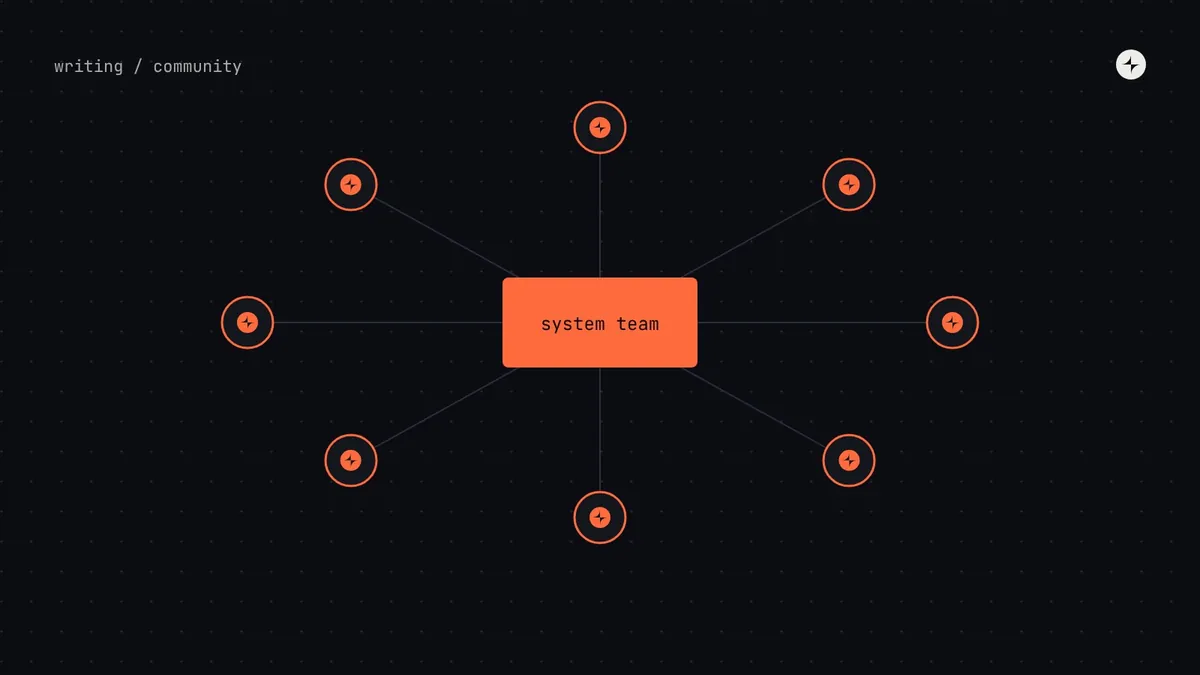
A design system champion is a designer or engineer in a product team who acts as the system's local advocate, helper and feedback channel, alongside their normal job. A champions network gives every team one designer and one engineer with about 5–10% of their week agreed with their manager, a fortnightly call, early access to releases and real influence over the roadmap. Around them, a small set of community rituals (a channel, a monthly session, working groups) turns a service desk into a community that multiplies the system team.
- Two things make or break it: champions' feedback must visibly change things, and managers must agree to the time.
- Start small. Empty community spaces are worse than missing ones.
- Recognise contributions publicly and in career frameworks.
From service desk to community
An illustration: five people serving two hundred
A system team of five supports 40 designers and 160 engineers. Every question, idea and fix goes through them.
The queue grows. Teams see the system team as slow and distant. Good ideas from product designers never reach the system because there's nowhere to share them.
Champions answer half the questions. A monthly session spreads good patterns between teams. Contributions arrive weekly. The five people steer and review, rather than doing everything.
A community doesn't replace the system team. It multiplies it. Nathan Curtis's observation that successful systems combine a central team with participation from a wider community is really an observation about community.
What champions do
| What it looks like | |
|---|---|
| What champions do | Help teammates use the system; bring their team's needs and frustrations to the system team; test previews early; relay important announcements; contribute where they can |
| Time | About 5–10% of their week, agreed with their manager |
| What they get | Early access, a direct line to the system team, influence over the roadmap, recognition, and credit in their career framework |
| How they're chosen | Volunteers, agreed with their manager; refreshed yearly so the role spreads |
| Rhythm | A fortnightly 30-minute champions call; a private channel; first look at every release |
Setting up a champions network
Get managers to agree the time
Write the 5–10% into team plans and the champion's goals. Champions doing this unofficially, on top of a full workload, burn out within months.
Ask for one designer and one engineer per team
Both disciplines, so the champion can help with Figma and with code.
Give them something real
A private channel, previews before every release, a seat in roadmap planning, and a named person in the system team to go to.
Run a fortnightly 30-minute call
What's coming, what's blocking teams, what champions are hearing. Keep notes and act on them.
Close the loop visibly
When a champion's feedback changes something, say so, by name, in the release notes.
If champions raise issues and nothing happens, they quietly stop. A champions network that only receives announcements is a mailing list. Make sure feedback visibly changes the roadmap.
The spaces a community needs
| Space | What happens there | Start at |
|---|---|---|
| Discussion channel | Ideas, show-and-tell, "how would you solve this?" | Startup |
| Champions channel | Early previews, coordination, feedback from each team | Scale-up |
| Proposals board | Written proposals for new components and big changes, open for comments | Scale-up |
| Monthly community session | Live show-and-tell, updates and discussion | Scale-up |
| Working groups | Small, time-boxed groups solving one shared problem | Mid-sized |
| Contributors' wall | A docs page celebrating contributions | Mid-sized |
Community rituals
The monthly community session
The heartbeat of the community: an hour, once a month, open to everyone, with a format people can rely on.
Other rituals worth running
Contribution day
Product designers and engineers pair with the system team on "good first issues". Great for first-time contributors.
Pattern clinic
Bring a tricky screen; the group works out the best pattern together. Often seeds new documentation.
Critique swaps
Designers from different teams review each other's screens through the lens of the system.
Working groups
Some problems are bigger than one component and need people from several teams: "our forms are inconsistent", "we need a data visualisation approach". A working group is three to six people from different product teams plus someone from the system team, set up to solve one such problem in a fixed time, typically six to twelve weeks. Give it a one-paragraph charter (problem, goal, members, duration, expected output) and end it with a documented result, such as a new pattern or a proposal.
Recognition
People contribute when contribution is noticed. Thank contributors by name in release notes and community sessions, keep a contributors' wall on the docs site, and work with managers so champion work and contributions count in performance reviews and career frameworks. Recognition is cheap; it's also the thing teams most often forget.
At IBM, the Riyadh Air design system was run by three companies with six named roles, a contribution model and seven shared routines. See the operating model.
The short version
- Champions are a designer and an engineer per team, with 5–10% of their time agreed.
- Give them early access, a direct line and real influence, and close the loop visibly.
- Add community spaces only when there's demand: channel, champions call, monthly session, working groups.
- Recognise contributions publicly and in career frameworks.
- A community multiplies the system team; it doesn't replace it.
Frequently asked questions
How much time should a design system champion spend?
About 5–10% of their week, agreed with their manager and written into their goals.
Should champions be senior?
Not necessarily. They need to be respected in their team, curious and willing. Rotating the role yearly spreads knowledge.
What if teams don't volunteer champions?
Start with the teams that already use the system most, show what champions get (early access, influence), and ask leadership to support the time in planning.
How do we measure community health?
Contributions per quarter and from how many teams, the share of help-channel questions answered by people outside the system team, and attendance at community sessions.
Further reading
- The Fallacy of Federated Design SystemsNathan Curtis.
- Contributions to Design SystemsNathan Curtis, EightShapes.
- Design system office hoursThe weekly help session champions feed.