Work / CARS24
 CARS24 · 2025 · Governance, Operations
How the design system team stopped being the bottleneck
As CARS24 grew, every team needed something from the design system, and one small team couldn't keep up. Requests piled up, nobody could see what was happening, and teams built around us. We changed how work came in, got decided and got built.
The 30-second version
The problem
Every request from every team ran through one small team. No front door, no shared rules, no way to help. Most requests just waited.
What we did
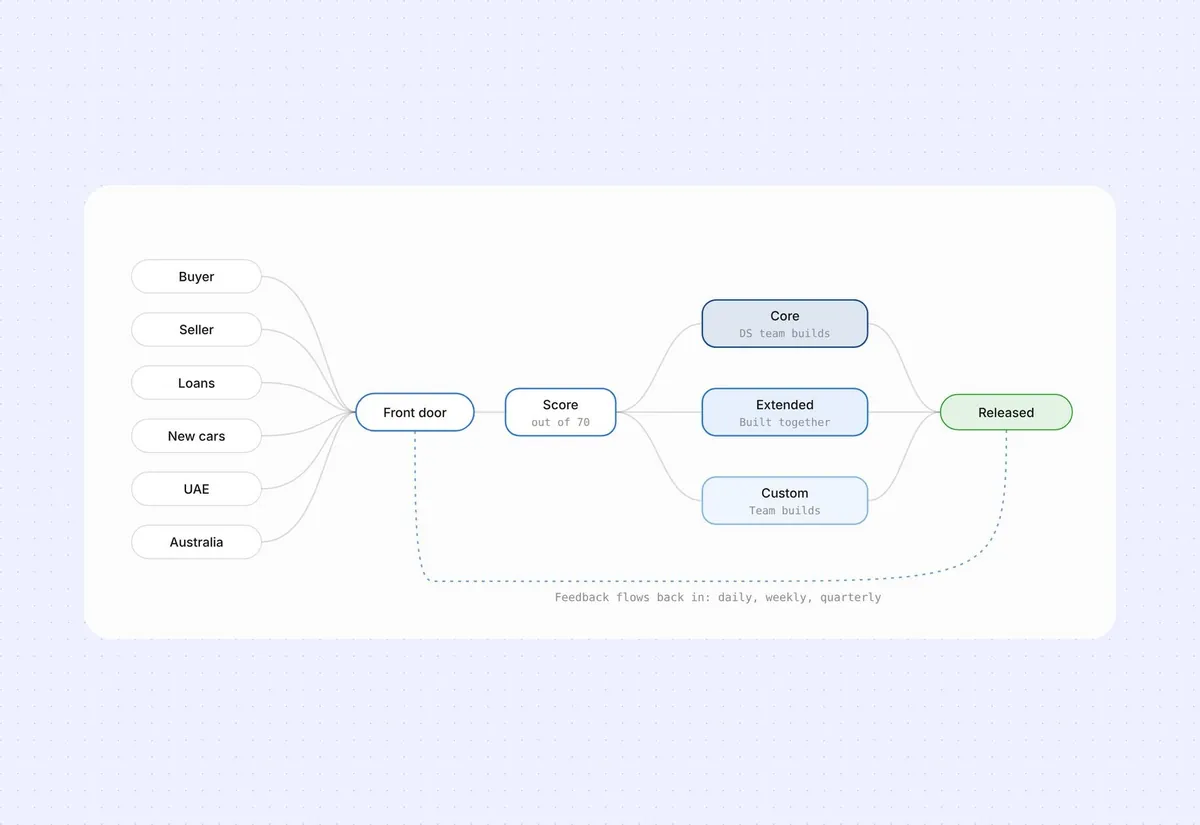
One front door, a 70-point scorecard anyone can apply, three ownership tiers, a contribution playbook and a steady listening rhythm.
What changed
Every decision came with a reason. Teams planned around releases, and more people built with the system instead of around it.
- 70 pts
- scorecard any team can apply
- 7 steps
- one path for every request
- 3 tiers
- core, extended and custom ownership
- 4
- listening rhythms: daily to quarterly
Six requests a week, one answered
Requests arrived by DM, Slack, meetings and hallway chats. Yes or no depended on who asked loudest, so teams stopped trusting the answer.
Product designer · Seller10:14
We need a custom card for car pricing on the seller flow. Can it go into the library? We launch in two weeks.
Frontend engineer · Loans11:02
Can we add a heatmap chart? Our dashboard needs one and I'd rather not build it from scratch.
Product designer · Buyer16:40
Our flow needs a special carousel. Is there a way to do it with what we have?
Product designer · New cars09:31
Can I add this new filter pattern? Happy to do the Figma work myself.
Mobile engineer · UAE12:05
We built a checkout component. Can other teams use it? Where would I even put it?
Product designer · Australia15:22
How do I propose a new button variant? Is there a form somewhere?
Recreated from real requests. Names removed.
No front door
Requests came in everywhere, so nobody could see them all, including us.
No shared rules
Answers depended on who asked, so teams couldn't predict them.
No way to help
Teams that had already built something had nowhere to put it.
We tried the usual frameworks first
Seven angles of research, from shadowing to surveys. Then we scored real requests with RICE and MoSCoW. With RICE, people argued about the numbers; with MoSCoW, everything was a Must.
RICE: tried
Weighs value against effort, but reach and confidence are guesses for a shared component. The score became the argument.
MoSCoW: tried
Quick and familiar, but every team's request was a Must, and the label never explained why.
Our scorecard: used
Four questions a product designer can answer without us: where, who reuses, do we have it, how hard.
Tested in the open
Requesters scored their own asks next to ours. Where it felt wrong, we adjusted it.
Read the detail
We interviewed designers, engineers and PMs; mapped where requests got stuck; looked at unused and stalled requests; benchmarked Base, Shopify Polaris and Agoda; surveyed how much teams trusted the process; ran experiments; and shadowed teams to watch delays happen live.
Every request takes the same path
A bug, a new variant or a whole new component: everything goes through the same seven steps, so anyone can tell where a request is and what happens next.
Step 1 of 7
Ask
Post in #design-system-help or fill in the proposal form: what it's for, who needs it and how often it comes up.
- Who
- Anyone
- When
- Any time
- What comes out
- A request with context
Step 2 of 7
Review
New requests are reviewed together. Anything unclear goes back as a question.
- Who
- Design system team and the requester
- When
- Weekly office hours
- What comes out
- A complete request
Step 3 of 7
Score
Four questions, out of 70. The score is shared, so the requester sees why it landed where it did.
- Who
- Design system team, in the open
- When
- At review
- What comes out
- A priority
Step 4 of 7
Decide
Accept, defer or reject. Every decision goes back to the team with the reason attached.
- Who
- Design system team
- When
- Same week
- What comes out
- A decision and a reason
Step 5 of 7
Build
Core work is built by the system team, extended work together, custom work stays with the product team.
- Who
- Depends on the tier
- When
- By priority
- What comes out
- A tokenised, accessible component
Step 6 of 7
Release
Documented in Figma and Storybook, announced with a changelog and migration steps.
- Who
- Design system team
- When
- Every release
- What comes out
- A note in #design-system-releases
Step 7 of 7
Check
Live screens are audited. Anything that has drifted comes back in as a new request, so step 7 feeds step 1.
- Who
- Design system team
- When
- Every quarter
- What comes out
- New requests for step 1
A score instead of an argument
Four plain questions, each worth points. Any ✕ stops a request. 55+ is accepted and built first, 40–54 accepted, under 40 deferred. Try it on a request of your own.
Not everything belongs in the core
Three rings. The closer to the centre, the more widely a component is used and the more the system team looks after it. Select a ring.
Used everywhere: buttons, inputs, tokens.
- Designs: system team
- Builds: system team
- Reviews: system team
- Maintains: system team
Used by a few teams: advanced filters, pricing cards.
- Designs: together
- Builds: product team
- Reviews: system team
- Maintains: together
One product, one use: a seasonal campaign card.
- Designs: product team
- Builds: product team
- Reviews: product team
- Maintains: product team
A system you set and forget falls apart
Listening was built into the routine at every speed, and a four-step playbook let teams contribute: propose, review and score, build together, document and release.
Daily: Slack help and release channelsWeekly: office hoursQuarterly: system audit
From gatekeeper to partner
Flip between before and after.
- Teams worked in silosA shared language and shared habits
- Forked styles and duplicate workConsistency through tokens and the system
- Rules handed down from the topContributions led by the community
- The design system was a blockerThe design system was an enabler
- Fear of changeTrust and collaboration
Designers
Trusted the tools and patterns.
Engineers
Started suggesting improvements themselves.
Product managers
Saw the system as a way to ship faster, and planned around releases.
The system team
Stopped being a bottleneck and became a facilitator.
What we'd do again
Agree on the goal first, and treat governance as the thing that lets you scale.
Agree on the goal first
Every later argument is easier when everyone signed up to the same outcome.
Governance is what lets you scale
Without it, more demand just means a longer queue.
Templates are lifelines
They made the right thing the easy thing.
Culture matters as much as code
The process only worked once people trusted it.
From the files
Select any image to see it full size.
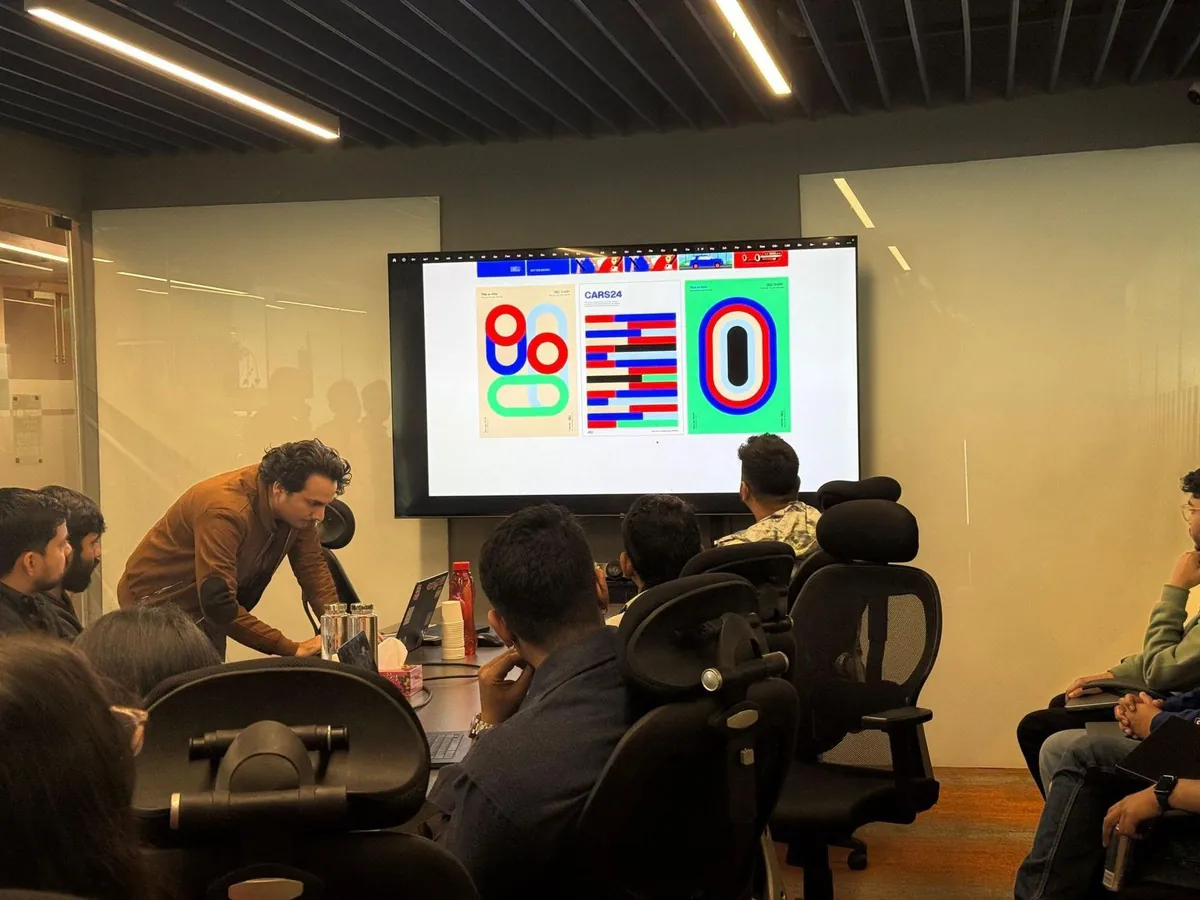
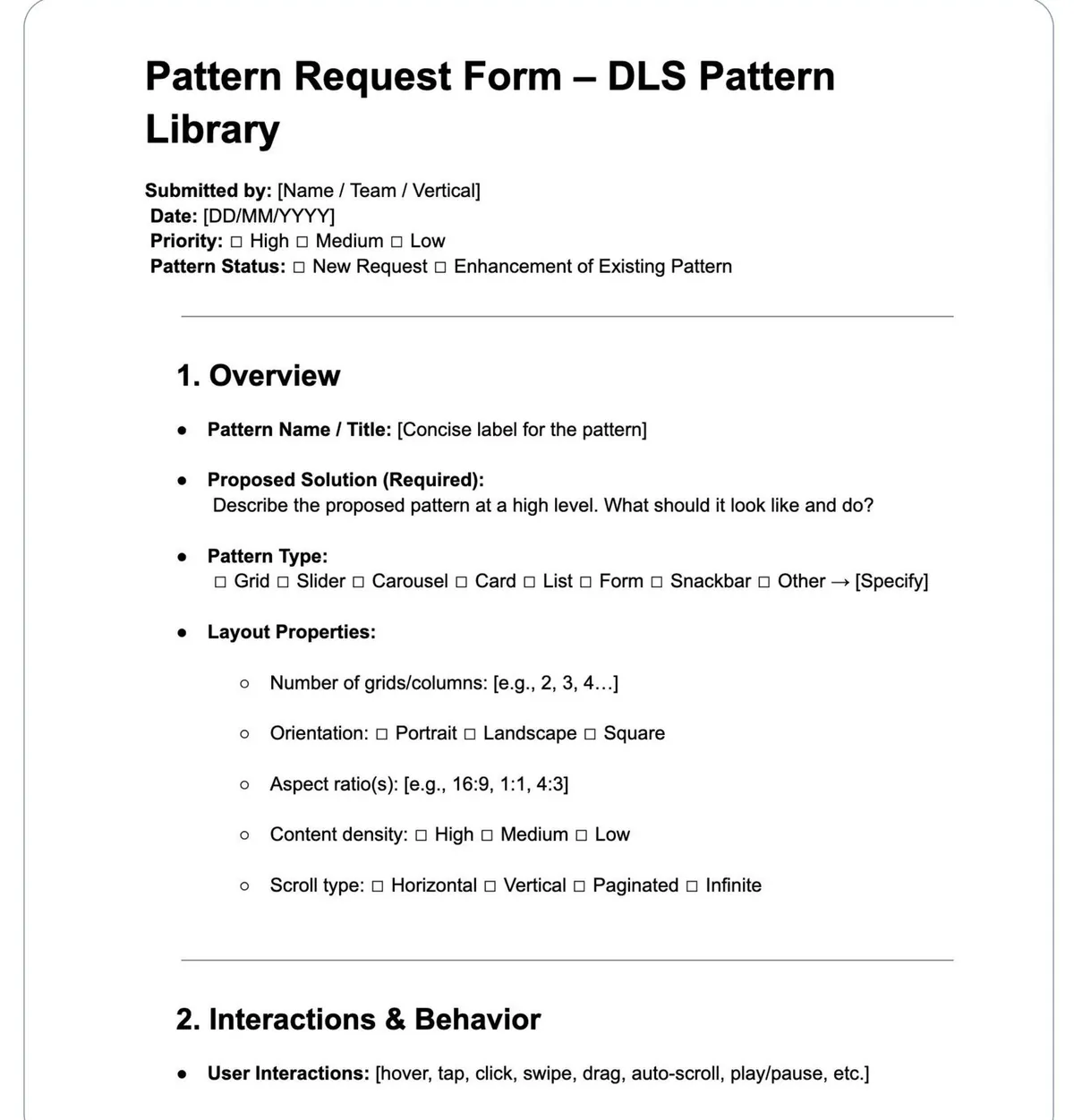
Led by Aniket Pandey as Design Systems Lead at CARS24, with CARS24's design, engineering and product teams. Images belong to CARS24 and are shown for portfolio purposes.
Need this for your product?
We do this work for product teams now. Start with a two-week audit.