Let me say something slightly uncomfortable.
Most Design System Leads are not actually leading design systems.
They are maintaining them.
And there’s a difference.
In many organizations, the “Design System Lead” role has quietly evolved into something operational. They manage the Figma library. They review component requests. They organize tokens. They update documentation. They answer Slack questions. They publish releases.
Important work? Absolutely. Leadership work? Not always.
Somewhere along the way, we started confusing asset management with system leadership. And that confusion is costing organizations more than they realize.
The Illusion of “One System”
If you’ve worked inside a mid to large organization, you already know this. There is never just one system.
There are multiple systems blooming in strange corners of the org. Product-specific libraries. Platform variations. Experimental sandboxes. Teams that forked the core system because they “needed flexibility.” Legacy components that still power critical flows.
And yet leadership often says, “We need one design system.” On paper, that sounds clean. In reality, what exists is a system of systems.
And this is where most design system leads stop short. They continue maintaining the core library while ignoring the ecosystem dynamics forming around it.
The Real Problem Isn’t Components
When we look closely at organizations operating with multiple systems, the pain rarely comes from missing components. The real tension usually comes from:
- Unclear ownership
- Undefined contribution pathways
- No release alignment
- Broken upgrade expectations
- Naming confusion
- Support model overlap
- Accessibility responsibility gaps
- Duplicate libraries that never converge
Teams don’t know who to go to for support. Extension systems use the core brand but don’t inherit the tokens. Product teams bypass governance because it feels rigid. Core teams don’t understand local product realities. Leadership wants cohesion but funds fragmentation.
The battlefield is alignment. Not buttons.
From Assets to Agreements
The biggest maturity jump in a design system is not from atoms to molecules. It’s from assets to agreements.
Most systems have some level of component maturity. Tokens exist. Patterns exist. Documentation exists. What’s missing is the contract.
An actual leadership-level system agreement addresses questions like:
- What belongs in the core and what doesn’t
- What versioning cadence everyone commits to
- What accessibility standards are non-negotiable
- How contributions move upward
- Who owns support at which layer
The Comfort Zone Trap
There’s a reason this happens. Design system practitioners are often idealists. We like clarity. Structure. Reuse. Harmony. We believe if we build the perfect core system, everything else will naturally align.
It rarely works that way. You can build the cleanest, most accessible, beautifully structured design system in the world. If you don’t define how other systems interact with it, they will: Duplicate it, Fork it, Misuse it, Rebrand it, or Ignore it.
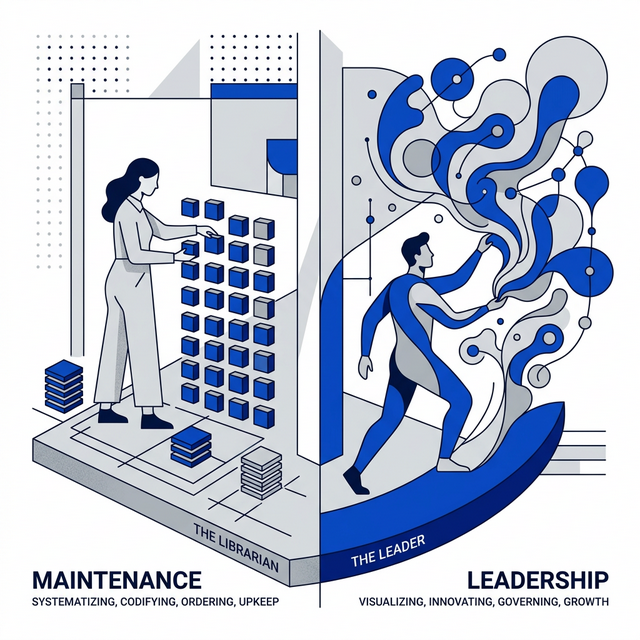
Librarian vs Leader
A librarian organizes knowledge. A leader shapes ecosystems.
Leadership in design systems looks different. It looks like: Defining boundaries between core and extension systems, Creating contribution and escalation models, Aligning release schedules across teams, and Managing naming optics strategically.
The Real Question
If you’re a design system lead, ask yourself: Am I designing components? Or am I designing how teams work together?
If you are not influencing governance, ownership, contribution, release cadence, and support models, you are not leading the system. You are maintaining it. And maintenance will always be reactive. Leadership is proactive.
The future of design systems does not belong to the teams with the cleanest component libraries. It belongs to the teams who understand that systems are not just technical artifacts. They are organizational agreements.